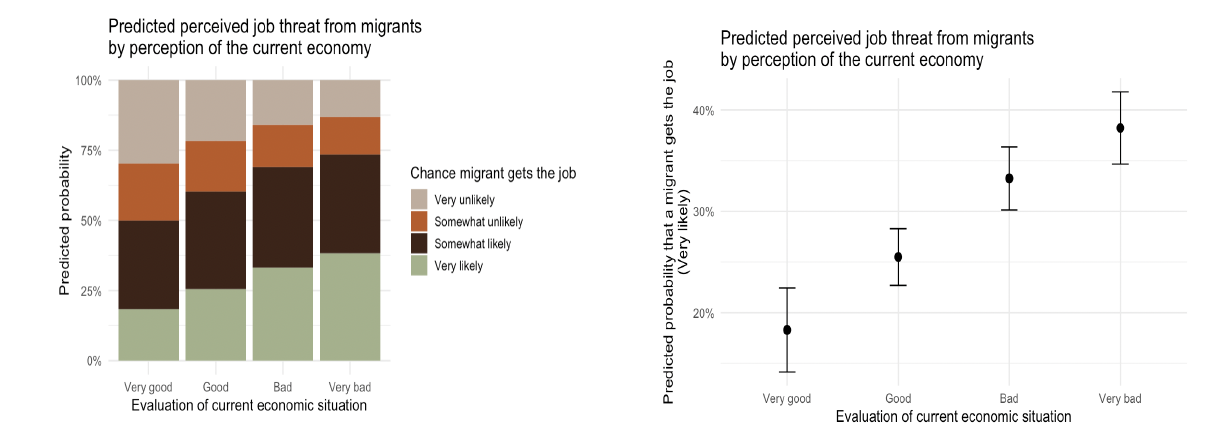
This project investigates whether economic pessimism is associated with attitudes toward migrants in the Middle East and North Africa, with a focus on Jordan and Lebanon. Using Arab Barometer Wave VIII survey data (about 15,000 respondents across the region), I clean and recode measures of economic evaluation, perceived labor market competition, and support for migrants’ rights, including a composite index capturing support for protections for foreign domestic workers. I first map descriptive patterns to show how economic concerns rank among citizens’ top priorities and how support varies across specific policy items. I then estimate regression models to test whether more pessimistic economic views predict lower support for migrant rights, while accounting for key demographic and political factors. To move beyond correlation, I use a simple process tracing framework to evaluate whether the data align with a plausible mechanism linking economic decline to pessimism, to blame, and ultimately to perceived migrant threat. The findings clarify when economic anxiety translates into exclusionary attitudes, and when it does not, offering policy-relevant insight into public opinion toward migrants in two high-pressure host contexts.
Shaped Attitudes: Economic Pessimism and Attitudes Toward Migrants in the MENA Region
Data Analysis
Shiny
Collaborative Work